36-Hour Estate Planning, Trust & Probate Law Specialization Package

Original price was: $1,620.Current price is: $360.

FREE FOR MOST MEMBERS

Join first, then login to BHBA+ to access this series.

One Big Beautiful Bill: Private Client and International Planning Provisions

It is big, but is it beautiful? If that is a question you have on the new tax law, this is a program not to be missed. Let this presentation provide you with a solid understanding of the One Big Beautiful Bill, with a particular emphasis on provisions relevant to private clients and international planning.

Like it or not, beautiful or not, it is likely to remain the law for the next several years and your clients will be asking how it impacts their personal situations. The presenters will emphasize the material provisions, planning opportunities, and pitfalls presented by the Act, and the application of the law to common client situations. So, this program will be instrumental in taking your understanding of the provisions and impact of the new law to greater heights headed into 2026.

Robert Berkson, Withers Bergman LLP
Alan Witlen, Withers Bergman LLP

Navigating Trust Taxation in California: A Guide for Practitioners

This presentation provides a comprehensive overview of trust taxation in California, focusing on the rules governing fiduciary income tax, residency considerations, and the allocation of income between beneficiaries and trusts. Attendees will gain insight into how California determines trust residency and the implications for multistate trusts. Key compliance requirements and recent legal developments will also be discussed to help trustees, practitioners and advisors navigate this complex area of the law.

Sonia Woodruff, California Franchise Tax Board

Attorney-Client Privilege in Common Interest Scenarios: Walking the Waiver Tight

In this program, Michael Brophy and Garen Kirakosian of Withers Bergman LLP will examine attorney-client privilege issues that arise in common interest and joint defense arrangements within the trusts and estates context. They will address how these relationships are formed, their scope, and the risks of waiver through litigation and discovery tactics. The program will examine complex scenarios involving co-trustees, successor trustees, and shifting allegiances, with practical strategies for preserving privilege and responding to discovery challenges.

Michael Brophy, Withers Bergman LLP
Garen Kirakosian, Withers Bergman LLP

Gifts With Purpose: Decoding the Types of Testamentary Gifts and Their Consequen

This presentation is intended to provide attorneys, whether acting as professional fiduciaries or advising them, with an overview of issues related to satisfying certain types of gifts, to support the proper and efficient administration of an estate or trust. This presentation will initially explain and illustrate the different types of gifts. Next, the presentation will summarize what the donee receives in addition to the gift itself, if anything, such as income or interest. Third, the presentation will discuss the tax ramifications of satisfying the different types of gifts, including which gifts carry out distributable net income (DNI) of an estate or trust, marital deduction issues, and the generation-skipping transfer tax consequences of certain gifts.

The Nuts and Bolts of Elder Law

This program will offer attorneys a foundational overview of “Elder Law” covering the legal, financial, and healthcare issues most often encountered in serving older clients. Topics include estate and incapacity planning, long-term care financing, Medi-Cal qualification issues, conservatorship procedures, and ethical considerations unique to representing seniors. Attendees will gain practical tools and resources to expand their practice and better meet the needs of an aging population.

Michael McDermott, Law Offices of Stuart D. Zimring

In Bitcoin, We Trust: Avoiding Administrative Pitfalls in Trusts and Estates with Large Concentrations of Crypto and Other Digital Assets

As cryptocurrencies and other digital assets continue their meteoric rise in popularity, the likelihood of those assets ending up in a trust or estate is at an all-time high. In recognition of that reality, this presentation is aimed at orienting attorneys to key issues affecting administration of trusts and estates with digital assets. In addition to identifying potential administrative pitfalls, it will also include best practices to limit potential liability when dealing with these novel and highly risky assets.

J.D. Rees, Sheppard, Mullin, Richter & Hampton LLP

Managing Real Estate in a Probate Proceeding

A lot goes into determining the when, why and how real property is sold in a probate proceeding such as an estate administration, a trust, a conservatorship or guardianship. This program examines the steps to take to obtain a court order authorizing a sale when it is required and the process of selling real property in the different type of court proceedings. Among the topics to be discussed are preliminary steps to take upon marshaling real property, the steps to take when it is determined that the real property needs to be sold and the recent changes to how brokers are compensated.

Carmen Alberio, ADR Services, Inc.
Nancy Sanborn, Berkshire Hathaway Home Services
Brian Joy, Berkshire Hathaway Home Services

A Battle With The U.K. Bare Trust—Let's Settle This Once And For All!

This presentation is a U.S.-U.K. connected individual focused presentation and is particularly timely in light of the recently effective change to the U.K. tax regime (as of April 6, 2025). There is much attention currently on the U.K. changes and elimination of the remittance based regime and traditional "non-dom" and "excluded property trust" planning. However, there are interesting opportunities available under the U.S.-U.K. Treaty for U.S. persons who are not yet considered U.K. long term residents and thus, not yet U.K. domiciled.

This presentation focuses on the operation of the U.S.-U.K. Estate Tax Treaty, with a particular emphasis on the important exception in the Treaty for a U.S. domiciliary who creates a U.S. trust (with non U.K. assets) prior to becoming U.K. domiciled which is considered a settlement. Where as for many years there was considerable focus on ensuring a trust was a bare trust, this type of settlement, which requires a non U.K. Trustee, with more limited powers to the Settlor than typical for a traditional U.S. revocable trust, takes on new importance to exclude the assets of the trust from U.K. inheritance tax if the settlor becomes U.K. domiciliary after the date it is settled.

The presentation also covers other mismatch areas where the Treaty may not assist, such as charitable gifts to entities which are not both U.S. and U.K. qualified, further increasing the potential benefit of the settlement exception. This presentation will be particularly relevant for attorneys who work with U.S. persons who spend considerable time living or working in the U.K., as well as for U.S. Trustees who may be called upon to serve for a trust that will be treated as a settlement in the U.K.

Laura A. Zwicker, Greenberg Glusker LLP
Stefanie Lipson, Greenberg Glusker LLP

2025 Trust, Probate, & Conservatorship Annual Litigation Update

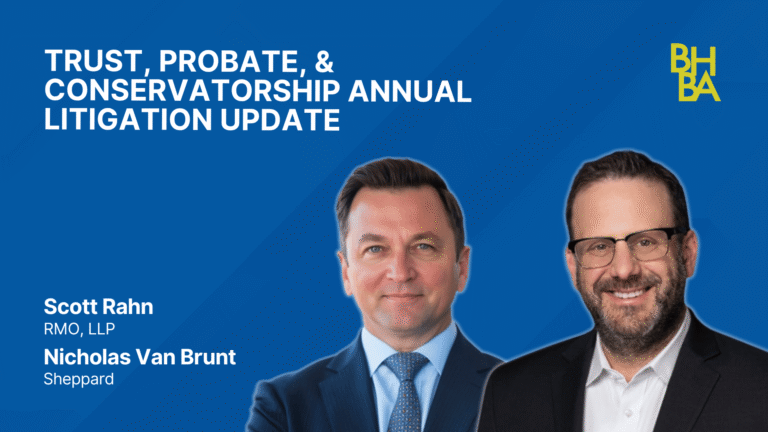
Scott Rahn and Nicholas Van Brunt provide a survey of appellate decisions concerning or relating to trusts, estates, and conservatorships in the last 12 months that are relevant to estate planners, administration counsel, and litigators.

Scott Rahn, RMO | Rahn Muntz O?Grady LLP
Nicholas Van Brunt, Sheppard Mullin Richter & Hampton LLP

Title Insurance & Escrow for Attorneys

This program provides attorneys with a focused overview of escrow and title company requirements when selling real property held in probate, conservatorship, or trust. Learn how to ensure a smooth closing by providing the correct legal documentation and resolving title issues that commonly arise in fiduciary sales. The program will also cover potential barriers to insurability and briefly address the impact of new NAR rules on broker compensation.

Nancy Sanborn, Berkshire Hathaway Home Services
Brian Joy, Berkshire Hathaway Home Services
Bill Thomas, Thomas Household
Stephanie Wolf, Pickford Escrow
Stella Ling, Berkshire Hathaway Home Services
Martha Mosier, Berkshire Hathaway Home Services

Estate Planning for Pets

The majority of households have pets that, in terms of the law, are considered tangible personal property. However, most households view these companion animals as members of their family. This presentation shows how to easily and effectively draft must-have pet-oriented boilerplate provisions for the estate planning client and comprehensive trusts for those clients who want special attention for their precious pet. This is another dimension of adding value to legal services.

Timothy Midura, The Brooks Institute for Animal Rights Law and Policy, Inc.

Immigration and Estate Planning Addressing Emergency Deportation and Detention

Join us for an informative webinar with speaker Alexandria Goff, Esq., which explores the intersection of immigration and estate planning, focusing on legal strategies to address emergency deportation and detention. Attorneys will gain a deeper understanding of how to safeguard clients’ rights, protect family continuity, and ensure the proper handling of assets during unexpected immigration crises. The program provides practical tools and insights to navigate these critical issues effectively.

Alexandria Goff, Esq, Founder, Goff Legal, PC

Small Estate Affidavits 101: Reviewing the Basics in light of AB 2016

This program will explore the small estate affidavit process and the changes introduced by Assembly Bill 2016, effective April 1, 2025. Our speakers will highlight the key updates in the new law and offer practical strategies for adapting estate planning practices to align with these changes.

Jordan C. Parr, Attorney, Hill, Farrer & Burrill LLP
Aubrey Van de Wetering, Associate, Withersworldwide

Real Estate Planning Gone Wrong: How to Avoid Becoming a Probate Horror Story

Estate planning in real estate transactions is crucial to ensure that properties pass smoothly and efficiently to heirs. Yet, numerous pitfalls can lead to costly and complicated probate battles. This program will explore common estate planning mistakes in real estate transactions and offer practical strategies to avoid costly probate issues.

SLATs in a New Tax Landscape

This presentation will cover the history and implementation of Spousal Limited Access Trusts, best practices for these flexible estate planning vehicles, and their ongoing utility in light of the recent election and anticipated future estate and gift tax landscape. We will also discuss significant concerns that can arise when a divorce occurs, or when a spousal beneficiary dies. Back-end SLATs have developed as a partial solution to some of these concerns, although we will discuss the increased complexity involved in the interplay between state and federal law in this arena.

The Elder Abuse Litigation Bundle: How to Prosecute It and Defend Against It

As elder financial abuse litigation has become more prevalent, knowing how to draft estate planning documents in order to prevent this claim, along with the “bundle claims” that usually accompany it, is crucial. This presentation will give estate planning attorneys some tips and tricks to ensure that their estate plans are upheld should this bundle of claims be litigated following the death of their client.

The Who, What, When, and How of Proper Notice in Trust and Estates Proceedings

This presentation will cover the due process notice requirements for all probate court matters, including probates, conservatorships/guardianships, and trust matters. The presentation will address:

- Who is entitled to receive notice
- What documents they are supposed to receive
- How and when they are supposed to receive notice

The presentation will also highlight the most common mistakes the probate court encounters and how to avoid them, as well as practical tips for ensuring that your hearings are never continued due to notice deficiencies.

Death of a Litigant: How to Pursue or Defend Against Claims When a Litigant Dies

People die. But the death of a litigant or debtor does not mean that the claim or debt dies with them. Join us for this program to learn all about initiating or continuing claims against a deceased party. We will discuss the applicable rules under both the Code of Civil Procedure and the Probate Code for bringing a claim or continuing litigation against a deceased party, and how to avoid miscalculating the period within which you must bring a claim against the decedent – or risk forfeiting it forever. We will also provide instructions on when and how to file a creditor’s claim against a decedent’s estate, and how to initiate a lawsuit against the decedent if your creditor’s claim gets rejected. This program will help plaintiffs and creditors navigate the creditors’ claims procedures, as well as fiduciaries and beneficiaries leverage those procedures to potentially limit liabilities.

This program is a must to understand and navigate the complicated rules governing claims against a decedent!

Ask the speaker a question. Email and be sure to include the program name in the subject
line.

Avoiding Pitfalls of Premarital Agreements and Estate Planning

Join attorneys Nathalie E. A. Paluch and Sara Z. May as they dive into important considerations when premarital agreements intersect with estate planning. The presentation will explore several hypotheticals and how to avoid common issues relating to estate planning, including how to ensure a divorcee is not better off than a widow, whether a premarital agreement should provide for consideration in the event of death, and how to navigate making a spouse a potential creditor of your posthumous estate.

INGS: A Retrospective and Alternatives

Incomplete gift, nongrantor trusts (INGs) were just a recent innovation in a long history stretching back to the decades prior to WWII of clients deploying trusts for their income tax benefits. In recent years, some high tax states have targeted the use of INGS for the state and local tax savings that these structures provided. How are taxpayers in these states responding to these changes? We will look at how ING structures work, how some states seek to invalidate them, and explore some of their remaining uses. We will also look at alternatives to ING structures and how these may be of use to obtain similar benefits.

Ask the speaker a question. Email and be sure to include the program name in the subject line.

Daniel C. Lorenzen, Partner, Venable LLP

Understanding Pooled Special Needs Trusts: Maximize Benefits For Your Clients

A D4C pooled trust is a type of pooled special needs trust specifically designed to hold the assets of individuals with disabilities. These are typically more affordable and quicker to establish than D4A stand-alone special needs trusts. However, they are an under-utilized tool in California. Our speaker, Michelle Wolf, will discuss the fundamentals of pooled special needs trust, legal considerations and best practices and case studies for how pooled special needs trusts can maximize benefits for your clients.

Ask the speaker a question. Email and be sure to include the program name in the subject line.

Protecting Trustees and Fiduciaries from Liability

This program will cover various aspects of protecting fiduciaries acting in financial or healthcare roles from liability for executing their duties. Our primary focus will be on financial management. We will also provide attendees with tools to determine whether they or their clients should take on certain fiduciary roles and ways to avoid liability when the fiduciaries are already acting.

Reducing, Deferring or Eliminating Capital Gains Taxes For Older Clients

Reducing, Deferring or Eliminating Capital Gains Taxes For Older Clients (Other Than 1031 Exchanges)

When an older client has an asset with a large capital gain, most advisors tell the client to hold it until he or she dies. In that way the heirs will get a step-up in basis to save them capital gains tax on a future sale.

However, the estate tax works in opposition to the capital gains tax. The estate tax is due on a date certain (9 months after the date of death, though there can be a 6 month extension, and the tax can be deferred over 15 years if more than 35% of the adjusted gross estate qualifies as a closely held business); and rate is 40% over the exclusion ($13,610,000 per person, to be cut in half in 2026).

The capital gains tax need not be paid because the heirs can decide to keep the property or enter into one of several structures (the purpose of our discussion) that reduce, defer or eliminate the capital gains tax; and rate is 37.1% over the asset's basis.

Our speaker, Bruce Givner, has been practicing tax law for over 47 years. He will share 8 ways to reduce, defer or eliminate the capital gains tax without considering an IRC Section 1031 exchange. The program is a must for any attorney, fiduciary or professional who may advise older clients with significant financial resources.

Tax-Efficient Charitable Giving for Entrepreneurs and Impactful Philanthropy

Explore the power of "Tax-Efficient Charitable Giving for Entrepreneurs" at the Beverly Hills Bar Association. This dynamic presentation will help you guide entrepreneurial clients—whether founders of family businesses or owners and investors in large enterprises—towards impactful philanthropy. Explore strategic approaches for outright giving and life income gifts, utilizing assets like cash, appreciated securities, business interests, and real estate. Enhance your expertise to help clients amplify their legacy, minimize tax exposure, and preserve wealth for future generations.

California’s Human Composting Law and Advance Health Care Directives

Join us for an exploration of AB351, known as the Reduction of Human Remains Act or Human Composting. This session offers an opportunity to understand this legislation and its impact. We'll also provide insightful guidance on Advanced Health Care Directives and other essential end-of-life documents, helping you navigate these important decisions with confidence and clarity.

The Dynamics of Intra-Family Trust and Estate Litigation

Join us for a presentation on the litigation landmines relating to intra-family estate planning and administration, including how professionals can spot and mitigate litigation issues as a service to their clients.

Basics of Elder Abuse Restraining Orders and Recent Updates

Elder Abuse Restraining Orders are an important tool to protect older and dependent adults from ongoing abuse and prevent future abuse. This presentation will educate advocates about the legal standards and procedure for obtaining an elder abuse restraining order for their clients and will cover recent updates to the law under Assembly Bill 1243.

What is on the Horizon for the Treatment of Major Neurocognitive Disorders

Our speaker, Sarah Mourra, MD, is double-board certified by the American Board of Psychiatry and Neurology in both Adult Psychiatry and Geriatric Psychiatry. She was selected as a Bureau of Health Professions Fellow in geriatric psychiatry and is currently an Assistant Clinical Professional of Psychiatry at UCLA David Geffen School of Medicine. It is critical for elder law attorneys to be aware of the latest treatments for dementia. This clinical understanding helps counsel provide appropriate legal advice for clients and their families facing the challenges of dementia. It also helps counsel consider alternatives other than conservatorships and, when conservatorships are necessary, guide the proceedings so that fiduciaries can act in the best interest of conservatees. Dr. Mourra will review the diagnostic criteria for dementia and the most current information and updates for the workup and treatments for the disease. The presentation is a must for any legal professional working to help older and other adults facing the challenges of dementia.

To Sell or Not to Sell: When is it time to Sell the Conservatee’s Residence?

Join us as we deep dive into the complexities of selling a conservatee’s property. The webinar will cover three main topics: determining the appropriate time for sale, steps to obtain a court order authorizing the transaction, and the process of executing the sale. This is a must-attend event for attorneys, conservators, and others involved in such real estate transactions.

AI in Estate Planning: Ethical and Practical Considerations

This program will explore the integration of AI in the traditionally human-centric fields of estate planning and family offices. Generative Artifical Intelligence (GenAI) is a groundbreaking technology, enabling advisors to streamline complex tasks such as estate summarization, document drafting, and client communications. While GenAI offers immense potential for efficiency, our panelists also discuss the critical importance of data privacy, the need for human oversight, and the irreplaceable value of personal client relationships. Join us to unlock the future possibilities of AI in these specialized domains.

Conservatorships in California: Navigating the Post-Britney Era

In response to the highly publicized case of Britney Spears, California’s conservatorship laws have undergone significant changes. This presentation will begin with a background of the perceived need for legal change, followed by a concise overview of the recent amendments and their implications for future conservatorship petitions, including new allegations and findings. The session will also address the evolving challenges and considerations for professional fiduciaries under these new laws. If time permits, the speaker will conclude with insights into national trends in conservatorship laws, offering a broader context for California's reforms.

Estate Planning Demystified: Wills, Trusts and Incapacity Documents

What is the difference between a will and a trust? Can a will help to avoid probate? How do I fund my trust?

These are just a few of the questions that estate planning attorneys hear. Join us for a comprehensive, nuts and bolts introduction to estate planning. During this program, we will cover the basics of estate planning, including wills, trusts, tax rules, trust funding, non-probate transfers, and incapacity documents.

This program is intended to provide a foundational understanding of the basics of estate planning. This is a great program for attorneys who are new to estate planning or who are interested in adding estate planning to their practice.

Proposition 19 Revisited: Proactive Planning Techniques and Practice Pointers

Proposition 19 introduced major changes to California property tax law that impact trust and estate planning throughout the state. The new law virtually eliminated certain tax benefits that have been enjoyed for decades and partly expanded the reach of others. Did you know that there are ways to reduce or eliminate the negative consequences of Proposition 19? Navigating these limitations takes proactive planning and due diligence and doing so correctly is likely to set you apart and place you and your clients at a significant advantage. Join us to learn about Prop 19, including recent updates, and the creative planning techniques available to lessen its burdens.

An Overview of Will and Trust Contests

This presentation will provide a broad overview of basic principles that are fundamental to will and trust contest litigation. It is designed for estate planners and others who do not primarily practice litigation and will cover topics including standing, different standards of legal capacity to execute estate planning documents, and factors in determining undue influence.

Governance Structures for Multigenerational Planning

This presentation will describe family governance structures commonly used in multigenerational planning when family unity and cohesion are important factors for the founding generation. Case studies will highlight good (and bad) use of governance planning. The presenters will focus on continuity planning for closely held family businesses along with governance planning for families whose holdings are large or complex enough to require thinking about the estate as an enterprise.

Andrea Kushner, Bernstein
Mark Powell, AdvicePeriod

Probate 101: Omitted Spouses and Children? AKA Post Planning Family Additions

This program will address: (1) What is a Surviving Spouse? (2) What at is an omitted spouse and an omitted child? (3) What are intestate shares? (4) How do you satisfy the omitted spouses' and children?s share? and (5) What are the legal proceedings to enforce their rights.

Estate 36

36-Hour Estate Planning, Trust & Probate Law Specialization Package

Original price was: $1,620.Current price is: $360.

Free for Most Members Join first, then login to BHBA+ to access this series.

One Big Beautiful Bill: Private Client and International Planning Provisions

It is big, but is it beautiful? If that is a question you have on the new tax law, this is a program not to be missed. Let this presentation provide you with a solid understanding of the One Big Beautiful Bill, with a particular emphasis on provisions relevant to private clients and international planning.

Like it or not, beautiful or not, it is likely to remain the law for the next several years and your clients will be asking how it impacts their personal situations. The presenters will emphasize the material provisions, planning opportunities, and pitfalls presented by the Act, and the application of the law to common client situations. So, this program will be instrumental in taking your understanding of the provisions and impact of the new law to greater heights headed into 2026.

Robert Berkson, Withers Bergman LLP
Alan Witlen, Withers Bergman LLP

Navigating Trust Taxation in California: A Guide for Practitioners

This presentation provides a comprehensive overview of trust taxation in California, focusing on the rules governing fiduciary income tax, residency considerations, and the allocation of income between beneficiaries and trusts. Attendees will gain insight into how California determines trust residency and the implications for multistate trusts. Key compliance requirements and recent legal developments will also be discussed to help trustees, practitioners and advisors navigate this complex area of the law.

Sonia Woodruff, California Franchise Tax Board

Attorney-Client Privilege in Common Interest Scenarios: Walking the Waiver Tight

In this program, Michael Brophy and Garen Kirakosian of Withers Bergman LLP will examine attorney-client privilege issues that arise in common interest and joint defense arrangements within the trusts and estates context. They will address how these relationships are formed, their scope, and the risks of waiver through litigation and discovery tactics. The program will examine complex scenarios involving co-trustees, successor trustees, and shifting allegiances, with practical strategies for preserving privilege and responding to discovery challenges.

Michael Brophy, Withers Bergman LLP
Garen Kirakosian, Withers Bergman LLP

Gifts With Purpose: Decoding the Types of Testamentary Gifts and Their Consequen

This presentation is intended to provide attorneys, whether acting as professional fiduciaries or advising them, with an overview of issues related to satisfying certain types of gifts, to support the proper and efficient administration of an estate or trust. This presentation will initially explain and illustrate the different types of gifts. Next, the presentation will summarize what the donee receives in addition to the gift itself, if anything, such as income or interest. Third, the presentation will discuss the tax ramifications of satisfying the different types of gifts, including which gifts carry out distributable net income (DNI) of an estate or trust, marital deduction issues, and the generation-skipping transfer tax consequences of certain gifts.

The Nuts and Bolts of Elder Law

This program will offer attorneys a foundational overview of “Elder Law” covering the legal, financial, and healthcare issues most often encountered in serving older clients. Topics include estate and incapacity planning, long-term care financing, Medi-Cal qualification issues, conservatorship procedures, and ethical considerations unique to representing seniors. Attendees will gain practical tools and resources to expand their practice and better meet the needs of an aging population.

Michael McDermott, Law Offices of Stuart D. Zimring

In Bitcoin, We Trust: Avoiding Administrative Pitfalls in Trusts and Estates with Large Concentrations of Crypto and Other Digital Assets

As cryptocurrencies and other digital assets continue their meteoric rise in popularity, the likelihood of those assets ending up in a trust or estate is at an all-time high. In recognition of that reality, this presentation is aimed at orienting attorneys to key issues affecting administration of trusts and estates with digital assets. In addition to identifying potential administrative pitfalls, it will also include best practices to limit potential liability when dealing with these novel and highly risky assets.

J.D. Rees, Sheppard, Mullin, Richter & Hampton LLP

Managing Real Estate in a Probate Proceeding

A lot goes into determining the when, why and how real property is sold in a probate proceeding such as an estate administration, a trust, a conservatorship or guardianship. This program examines the steps to take to obtain a court order authorizing a sale when it is required and the process of selling real property in the different type of court proceedings. Among the topics to be discussed are preliminary steps to take upon marshaling real property, the steps to take when it is determined that the real property needs to be sold and the recent changes to how brokers are compensated.

Carmen Alberio, ADR Services, Inc.
Nancy Sanborn, Berkshire Hathaway Home Services
Brian Joy, Berkshire Hathaway Home Services

A Battle With The U.K. Bare Trust—Let's Settle This Once And For All!

This presentation is a U.S.-U.K. connected individual focused presentation and is particularly timely in light of the recently effective change to the U.K. tax regime (as of April 6, 2025). There is much attention currently on the U.K. changes and elimination of the remittance based regime and traditional "non-dom" and "excluded property trust" planning. However, there are interesting opportunities available under the U.S.-U.K. Treaty for U.S. persons who are not yet considered U.K. long term residents and thus, not yet U.K. domiciled.

This presentation focuses on the operation of the U.S.-U.K. Estate Tax Treaty, with a particular emphasis on the important exception in the Treaty for a U.S. domiciliary who creates a U.S. trust (with non U.K. assets) prior to becoming U.K. domiciled which is considered a settlement. Where as for many years there was considerable focus on ensuring a trust was a bare trust, this type of settlement, which requires a non U.K. Trustee, with more limited powers to the Settlor than typical for a traditional U.S. revocable trust, takes on new importance to exclude the assets of the trust from U.K. inheritance tax if the settlor becomes U.K. domiciliary after the date it is settled.

The presentation also covers other mismatch areas where the Treaty may not assist, such as charitable gifts to entities which are not both U.S. and U.K. qualified, further increasing the potential benefit of the settlement exception. This presentation will be particularly relevant for attorneys who work with U.S. persons who spend considerable time living or working in the U.K., as well as for U.S. Trustees who may be called upon to serve for a trust that will be treated as a settlement in the U.K.

Laura A. Zwicker, Greenberg Glusker LLP
Stefanie Lipson, Greenberg Glusker LLP

2025 Trust, Probate, & Conservatorship Annual Litigation Update

Scott Rahn and Nicholas Van Brunt provide a survey of appellate decisions concerning or relating to trusts, estates, and conservatorships in the last 12 months that are relevant to estate planners, administration counsel, and litigators.

Scott Rahn, RMO | Rahn Muntz O?Grady LLP
Nicholas Van Brunt, Sheppard Mullin Richter & Hampton LLP

Title Insurance & Escrow for Attorneys

This program provides attorneys with a focused overview of escrow and title company requirements when selling real property held in probate, conservatorship, or trust. Learn how to ensure a smooth closing by providing the correct legal documentation and resolving title issues that commonly arise in fiduciary sales. The program will also cover potential barriers to insurability and briefly address the impact of new NAR rules on broker compensation.

Nancy Sanborn, Berkshire Hathaway Home Services
Brian Joy, Berkshire Hathaway Home Services
Bill Thomas, Thomas Household
Stephanie Wolf, Pickford Escrow
Stella Ling, Berkshire Hathaway Home Services
Martha Mosier, Berkshire Hathaway Home Services

Estate Planning for Pets

The majority of households have pets that, in terms of the law, are considered tangible personal property. However, most households view these companion animals as members of their family. This presentation shows how to easily and effectively draft must-have pet-oriented boilerplate provisions for the estate planning client and comprehensive trusts for those clients who want special attention for their precious pet. This is another dimension of adding value to legal services.

Timothy Midura, The Brooks Institute for Animal Rights Law and Policy, Inc.

Immigration and Estate Planning Addressing Emergency Deportation and Detention

Join us for an informative webinar with speaker Alexandria Goff, Esq., which explores the intersection of immigration and estate planning, focusing on legal strategies to address emergency deportation and detention. Attorneys will gain a deeper understanding of how to safeguard clients’ rights, protect family continuity, and ensure the proper handling of assets during unexpected immigration crises. The program provides practical tools and insights to navigate these critical issues effectively.

Alexandria Goff, Esq, Founder, Goff Legal, PC

Small Estate Affidavits 101: Reviewing the Basics in light of AB 2016

This program will explore the small estate affidavit process and the changes introduced by Assembly Bill 2016, effective April 1, 2025. Our speakers will highlight the key updates in the new law and offer practical strategies for adapting estate planning practices to align with these changes.

Jordan C. Parr, Attorney, Hill, Farrer & Burrill LLP
Aubrey Van de Wetering, Associate, Withersworldwide

Real Estate Planning Gone Wrong: How to Avoid Becoming a Probate Horror Story

Estate planning in real estate transactions is crucial to ensure that properties pass smoothly and efficiently to heirs. Yet, numerous pitfalls can lead to costly and complicated probate battles. This program will explore common estate planning mistakes in real estate transactions and offer practical strategies to avoid costly probate issues.

SLATs in a New Tax Landscape

This presentation will cover the history and implementation of Spousal Limited Access Trusts, best practices for these flexible estate planning vehicles, and their ongoing utility in light of the recent election and anticipated future estate and gift tax landscape. We will also discuss significant concerns that can arise when a divorce occurs, or when a spousal beneficiary dies. Back-end SLATs have developed as a partial solution to some of these concerns, although we will discuss the increased complexity involved in the interplay between state and federal law in this arena.

The Elder Abuse Litigation Bundle: How to Prosecute It and Defend Against It

As elder financial abuse litigation has become more prevalent, knowing how to draft estate planning documents in order to prevent this claim, along with the “bundle claims” that usually accompany it, is crucial. This presentation will give estate planning attorneys some tips and tricks to ensure that their estate plans are upheld should this bundle of claims be litigated following the death of their client.

The Who, What, When, and How of Proper Notice in Trust and Estates Proceedings

This presentation will cover the due process notice requirements for all probate court matters, including probates, conservatorships/guardianships, and trust matters. The presentation will address:

- Who is entitled to receive notice
- What documents they are supposed to receive
- How and when they are supposed to receive notice

The presentation will also highlight the most common mistakes the probate court encounters and how to avoid them, as well as practical tips for ensuring that your hearings are never continued due to notice deficiencies.

Death of a Litigant: How to Pursue or Defend Against Claims When a Litigant Dies

People die. But the death of a litigant or debtor does not mean that the claim or debt dies with them. Join us for this program to learn all about initiating or continuing claims against a deceased party. We will discuss the applicable rules under both the Code of Civil Procedure and the Probate Code for bringing a claim or continuing litigation against a deceased party, and how to avoid miscalculating the period within which you must bring a claim against the decedent – or risk forfeiting it forever. We will also provide instructions on when and how to file a creditor’s claim against a decedent’s estate, and how to initiate a lawsuit against the decedent if your creditor’s claim gets rejected. This program will help plaintiffs and creditors navigate the creditors’ claims procedures, as well as fiduciaries and beneficiaries leverage those procedures to potentially limit liabilities.

This program is a must to understand and navigate the complicated rules governing claims against a decedent!

Ask the speaker a question. Email and be sure to include the program name in the subject
line.

Avoiding Pitfalls of Premarital Agreements and Estate Planning

Join attorneys Nathalie E. A. Paluch and Sara Z. May as they dive into important considerations when premarital agreements intersect with estate planning. The presentation will explore several hypotheticals and how to avoid common issues relating to estate planning, including how to ensure a divorcee is not better off than a widow, whether a premarital agreement should provide for consideration in the event of death, and how to navigate making a spouse a potential creditor of your posthumous estate.

INGS: A Retrospective and Alternatives

Incomplete gift, nongrantor trusts (INGs) were just a recent innovation in a long history stretching back to the decades prior to WWII of clients deploying trusts for their income tax benefits. In recent years, some high tax states have targeted the use of INGS for the state and local tax savings that these structures provided. How are taxpayers in these states responding to these changes? We will look at how ING structures work, how some states seek to invalidate them, and explore some of their remaining uses. We will also look at alternatives to ING structures and how these may be of use to obtain similar benefits.

Ask the speaker a question. Email and be sure to include the program name in the subject line.

Daniel C. Lorenzen, Partner, Venable LLP

Understanding Pooled Special Needs Trusts: Maximize Benefits For Your Clients

A D4C pooled trust is a type of pooled special needs trust specifically designed to hold the assets of individuals with disabilities. These are typically more affordable and quicker to establish than D4A stand-alone special needs trusts. However, they are an under-utilized tool in California. Our speaker, Michelle Wolf, will discuss the fundamentals of pooled special needs trust, legal considerations and best practices and case studies for how pooled special needs trusts can maximize benefits for your clients.

Ask the speaker a question. Email and be sure to include the program name in the subject line.

Protecting Trustees and Fiduciaries from Liability

This program will cover various aspects of protecting fiduciaries acting in financial or healthcare roles from liability for executing their duties. Our primary focus will be on financial management. We will also provide attendees with tools to determine whether they or their clients should take on certain fiduciary roles and ways to avoid liability when the fiduciaries are already acting.

Reducing, Deferring or Eliminating Capital Gains Taxes For Older Clients

Reducing, Deferring or Eliminating Capital Gains Taxes For Older Clients (Other Than 1031 Exchanges)

When an older client has an asset with a large capital gain, most advisors tell the client to hold it until he or she dies. In that way the heirs will get a step-up in basis to save them capital gains tax on a future sale.

However, the estate tax works in opposition to the capital gains tax. The estate tax is due on a date certain (9 months after the date of death, though there can be a 6 month extension, and the tax can be deferred over 15 years if more than 35% of the adjusted gross estate qualifies as a closely held business); and rate is 40% over the exclusion ($13,610,000 per person, to be cut in half in 2026).

The capital gains tax need not be paid because the heirs can decide to keep the property or enter into one of several structures (the purpose of our discussion) that reduce, defer or eliminate the capital gains tax; and rate is 37.1% over the asset's basis.

Our speaker, Bruce Givner, has been practicing tax law for over 47 years. He will share 8 ways to reduce, defer or eliminate the capital gains tax without considering an IRC Section 1031 exchange. The program is a must for any attorney, fiduciary or professional who may advise older clients with significant financial resources.

Tax-Efficient Charitable Giving for Entrepreneurs and Impactful Philanthropy

Explore the power of "Tax-Efficient Charitable Giving for Entrepreneurs" at the Beverly Hills Bar Association. This dynamic presentation will help you guide entrepreneurial clients—whether founders of family businesses or owners and investors in large enterprises—towards impactful philanthropy. Explore strategic approaches for outright giving and life income gifts, utilizing assets like cash, appreciated securities, business interests, and real estate. Enhance your expertise to help clients amplify their legacy, minimize tax exposure, and preserve wealth for future generations.

California’s Human Composting Law and Advance Health Care Directives

Join us for an exploration of AB351, known as the Reduction of Human Remains Act or Human Composting. This session offers an opportunity to understand this legislation and its impact. We'll also provide insightful guidance on Advanced Health Care Directives and other essential end-of-life documents, helping you navigate these important decisions with confidence and clarity.

The Dynamics of Intra-Family Trust and Estate Litigation

Join us for a presentation on the litigation landmines relating to intra-family estate planning and administration, including how professionals can spot and mitigate litigation issues as a service to their clients.

Basics of Elder Abuse Restraining Orders and Recent Updates

Elder Abuse Restraining Orders are an important tool to protect older and dependent adults from ongoing abuse and prevent future abuse. This presentation will educate advocates about the legal standards and procedure for obtaining an elder abuse restraining order for their clients and will cover recent updates to the law under Assembly Bill 1243.

What is on the Horizon for the Treatment of Major Neurocognitive Disorders

Our speaker, Sarah Mourra, MD, is double-board certified by the American Board of Psychiatry and Neurology in both Adult Psychiatry and Geriatric Psychiatry. She was selected as a Bureau of Health Professions Fellow in geriatric psychiatry and is currently an Assistant Clinical Professional of Psychiatry at UCLA David Geffen School of Medicine. It is critical for elder law attorneys to be aware of the latest treatments for dementia. This clinical understanding helps counsel provide appropriate legal advice for clients and their families facing the challenges of dementia. It also helps counsel consider alternatives other than conservatorships and, when conservatorships are necessary, guide the proceedings so that fiduciaries can act in the best interest of conservatees. Dr. Mourra will review the diagnostic criteria for dementia and the most current information and updates for the workup and treatments for the disease. The presentation is a must for any legal professional working to help older and other adults facing the challenges of dementia.

To Sell or Not to Sell: When is it time to Sell the Conservatee’s Residence?

Join us as we deep dive into the complexities of selling a conservatee’s property. The webinar will cover three main topics: determining the appropriate time for sale, steps to obtain a court order authorizing the transaction, and the process of executing the sale. This is a must-attend event for attorneys, conservators, and others involved in such real estate transactions.

AI in Estate Planning: Ethical and Practical Considerations

This program will explore the integration of AI in the traditionally human-centric fields of estate planning and family offices. Generative Artifical Intelligence (GenAI) is a groundbreaking technology, enabling advisors to streamline complex tasks such as estate summarization, document drafting, and client communications. While GenAI offers immense potential for efficiency, our panelists also discuss the critical importance of data privacy, the need for human oversight, and the irreplaceable value of personal client relationships. Join us to unlock the future possibilities of AI in these specialized domains.

Conservatorships in California: Navigating the Post-Britney Era

In response to the highly publicized case of Britney Spears, California’s conservatorship laws have undergone significant changes. This presentation will begin with a background of the perceived need for legal change, followed by a concise overview of the recent amendments and their implications for future conservatorship petitions, including new allegations and findings. The session will also address the evolving challenges and considerations for professional fiduciaries under these new laws. If time permits, the speaker will conclude with insights into national trends in conservatorship laws, offering a broader context for California's reforms.

Estate Planning Demystified: Wills, Trusts and Incapacity Documents

What is the difference between a will and a trust? Can a will help to avoid probate? How do I fund my trust?

These are just a few of the questions that estate planning attorneys hear. Join us for a comprehensive, nuts and bolts introduction to estate planning. During this program, we will cover the basics of estate planning, including wills, trusts, tax rules, trust funding, non-probate transfers, and incapacity documents.

This program is intended to provide a foundational understanding of the basics of estate planning. This is a great program for attorneys who are new to estate planning or who are interested in adding estate planning to their practice.

Proposition 19 Revisited: Proactive Planning Techniques and Practice Pointers

Proposition 19 introduced major changes to California property tax law that impact trust and estate planning throughout the state. The new law virtually eliminated certain tax benefits that have been enjoyed for decades and partly expanded the reach of others. Did you know that there are ways to reduce or eliminate the negative consequences of Proposition 19? Navigating these limitations takes proactive planning and due diligence and doing so correctly is likely to set you apart and place you and your clients at a significant advantage. Join us to learn about Prop 19, including recent updates, and the creative planning techniques available to lessen its burdens.

An Overview of Will and Trust Contests

This presentation will provide a broad overview of basic principles that are fundamental to will and trust contest litigation. It is designed for estate planners and others who do not primarily practice litigation and will cover topics including standing, different standards of legal capacity to execute estate planning documents, and factors in determining undue influence.

Governance Structures for Multigenerational Planning

This presentation will describe family governance structures commonly used in multigenerational planning when family unity and cohesion are important factors for the founding generation. Case studies will highlight good (and bad) use of governance planning. The presenters will focus on continuity planning for closely held family businesses along with governance planning for families whose holdings are large or complex enough to require thinking about the estate as an enterprise.

Andrea Kushner, Bernstein
Mark Powell, AdvicePeriod

Probate 101: Omitted Spouses and Children? AKA Post Planning Family Additions

This program will address: (1) What is a Surviving Spouse? (2) What at is an omitted spouse and an omitted child? (3) What are intestate shares? (4) How do you satisfy the omitted spouses' and children?s share? and (5) What are the legal proceedings to enforce their rights.

Estate 36
About the Series

This package fulfills your California Estate Planning, Trust, and Probate Law LSCLE requirements.

One Big Beautiful Bill: Private Client and International Planning Provisions

It is big, but is it beautiful? If that is a question you have on the new tax law, this is a program not to be missed. Let this presentation provide you with a solid understanding of the One Big Beautiful Bill, with a particular emphasis on provisions relevant to private clients and international planning.

Like it or not, beautiful or not, it is likely to remain the law for the next several years and your clients will be asking how it impacts their personal situations. The presenters will emphasize the material provisions, planning opportunities, and pitfalls presented by the Act, and the application of the law to common client situations. So, this program will be instrumental in taking your understanding of the provisions and impact of the new law to greater heights headed into 2026.

Robert Berkson, Withers Bergman LLP
Alan Witlen, Withers Bergman LLP

Navigating Trust Taxation in California: A Guide for Practitioners

This presentation provides a comprehensive overview of trust taxation in California, focusing on the rules governing fiduciary income tax, residency considerations, and the allocation of income between beneficiaries and trusts. Attendees will gain insight into how California determines trust residency and the implications for multistate trusts. Key compliance requirements and recent legal developments will also be discussed to help trustees, practitioners and advisors navigate this complex area of the law.

Sonia Woodruff, California Franchise Tax Board

Attorney-Client Privilege in Common Interest Scenarios: Walking the Waiver Tight

In this program, Michael Brophy and Garen Kirakosian of Withers Bergman LLP will examine attorney-client privilege issues that arise in common interest and joint defense arrangements within the trusts and estates context. They will address how these relationships are formed, their scope, and the risks of waiver through litigation and discovery tactics. The program will examine complex scenarios involving co-trustees, successor trustees, and shifting allegiances, with practical strategies for preserving privilege and responding to discovery challenges.

Michael Brophy, Withers Bergman LLP
Garen Kirakosian, Withers Bergman LLP

Gifts With Purpose: Decoding the Types of Testamentary Gifts and Their Consequen

This presentation is intended to provide attorneys, whether acting as professional fiduciaries or advising them, with an overview of issues related to satisfying certain types of gifts, to support the proper and efficient administration of an estate or trust. This presentation will initially explain and illustrate the different types of gifts. Next, the presentation will summarize what the donee receives in addition to the gift itself, if anything, such as income or interest. Third, the presentation will discuss the tax ramifications of satisfying the different types of gifts, including which gifts carry out distributable net income (DNI) of an estate or trust, marital deduction issues, and the generation-skipping transfer tax consequences of certain gifts.

The Nuts and Bolts of Elder Law

This program will offer attorneys a foundational overview of “Elder Law” covering the legal, financial, and healthcare issues most often encountered in serving older clients. Topics include estate and incapacity planning, long-term care financing, Medi-Cal qualification issues, conservatorship procedures, and ethical considerations unique to representing seniors. Attendees will gain practical tools and resources to expand their practice and better meet the needs of an aging population.

Michael McDermott, Law Offices of Stuart D. Zimring

In Bitcoin, We Trust: Avoiding Administrative Pitfalls in Trusts and Estates with Large Concentrations of Crypto and Other Digital Assets

As cryptocurrencies and other digital assets continue their meteoric rise in popularity, the likelihood of those assets ending up in a trust or estate is at an all-time high. In recognition of that reality, this presentation is aimed at orienting attorneys to key issues affecting administration of trusts and estates with digital assets. In addition to identifying potential administrative pitfalls, it will also include best practices to limit potential liability when dealing with these novel and highly risky assets.

J.D. Rees, Sheppard, Mullin, Richter & Hampton LLP

Managing Real Estate in a Probate Proceeding

A lot goes into determining the when, why and how real property is sold in a probate proceeding such as an estate administration, a trust, a conservatorship or guardianship. This program examines the steps to take to obtain a court order authorizing a sale when it is required and the process of selling real property in the different type of court proceedings. Among the topics to be discussed are preliminary steps to take upon marshaling real property, the steps to take when it is determined that the real property needs to be sold and the recent changes to how brokers are compensated.

Carmen Alberio, ADR Services, Inc.
Nancy Sanborn, Berkshire Hathaway Home Services
Brian Joy, Berkshire Hathaway Home Services

A Battle With The U.K. Bare Trust—Let's Settle This Once And For All!

This presentation is a U.S.-U.K. connected individual focused presentation and is particularly timely in light of the recently effective change to the U.K. tax regime (as of April 6, 2025). There is much attention currently on the U.K. changes and elimination of the remittance based regime and traditional "non-dom" and "excluded property trust" planning. However, there are interesting opportunities available under the U.S.-U.K. Treaty for U.S. persons who are not yet considered U.K. long term residents and thus, not yet U.K. domiciled.

This presentation focuses on the operation of the U.S.-U.K. Estate Tax Treaty, with a particular emphasis on the important exception in the Treaty for a U.S. domiciliary who creates a U.S. trust (with non U.K. assets) prior to becoming U.K. domiciled which is considered a settlement. Where as for many years there was considerable focus on ensuring a trust was a bare trust, this type of settlement, which requires a non U.K. Trustee, with more limited powers to the Settlor than typical for a traditional U.S. revocable trust, takes on new importance to exclude the assets of the trust from U.K. inheritance tax if the settlor becomes U.K. domiciliary after the date it is settled.

The presentation also covers other mismatch areas where the Treaty may not assist, such as charitable gifts to entities which are not both U.S. and U.K. qualified, further increasing the potential benefit of the settlement exception. This presentation will be particularly relevant for attorneys who work with U.S. persons who spend considerable time living or working in the U.K., as well as for U.S. Trustees who may be called upon to serve for a trust that will be treated as a settlement in the U.K.

Laura A. Zwicker, Greenberg Glusker LLP
Stefanie Lipson, Greenberg Glusker LLP

2025 Trust, Probate, & Conservatorship Annual Litigation Update

Scott Rahn and Nicholas Van Brunt provide a survey of appellate decisions concerning or relating to trusts, estates, and conservatorships in the last 12 months that are relevant to estate planners, administration counsel, and litigators.

Scott Rahn, RMO | Rahn Muntz O?Grady LLP
Nicholas Van Brunt, Sheppard Mullin Richter & Hampton LLP

Title Insurance & Escrow for Attorneys

This program provides attorneys with a focused overview of escrow and title company requirements when selling real property held in probate, conservatorship, or trust. Learn how to ensure a smooth closing by providing the correct legal documentation and resolving title issues that commonly arise in fiduciary sales. The program will also cover potential barriers to insurability and briefly address the impact of new NAR rules on broker compensation.

Nancy Sanborn, Berkshire Hathaway Home Services
Brian Joy, Berkshire Hathaway Home Services
Bill Thomas, Thomas Household
Stephanie Wolf, Pickford Escrow
Stella Ling, Berkshire Hathaway Home Services
Martha Mosier, Berkshire Hathaway Home Services

Estate Planning for Pets

The majority of households have pets that, in terms of the law, are considered tangible personal property. However, most households view these companion animals as members of their family. This presentation shows how to easily and effectively draft must-have pet-oriented boilerplate provisions for the estate planning client and comprehensive trusts for those clients who want special attention for their precious pet. This is another dimension of adding value to legal services.

Timothy Midura, The Brooks Institute for Animal Rights Law and Policy, Inc.

Immigration and Estate Planning Addressing Emergency Deportation and Detention

Join us for an informative webinar with speaker Alexandria Goff, Esq., which explores the intersection of immigration and estate planning, focusing on legal strategies to address emergency deportation and detention. Attorneys will gain a deeper understanding of how to safeguard clients’ rights, protect family continuity, and ensure the proper handling of assets during unexpected immigration crises. The program provides practical tools and insights to navigate these critical issues effectively.

Alexandria Goff, Esq, Founder, Goff Legal, PC

Small Estate Affidavits 101: Reviewing the Basics in light of AB 2016

This program will explore the small estate affidavit process and the changes introduced by Assembly Bill 2016, effective April 1, 2025. Our speakers will highlight the key updates in the new law and offer practical strategies for adapting estate planning practices to align with these changes.

Jordan C. Parr, Attorney, Hill, Farrer & Burrill LLP
Aubrey Van de Wetering, Associate, Withersworldwide

Real Estate Planning Gone Wrong: How to Avoid Becoming a Probate Horror Story

Estate planning in real estate transactions is crucial to ensure that properties pass smoothly and efficiently to heirs. Yet, numerous pitfalls can lead to costly and complicated probate battles. This program will explore common estate planning mistakes in real estate transactions and offer practical strategies to avoid costly probate issues.

SLATs in a New Tax Landscape

This presentation will cover the history and implementation of Spousal Limited Access Trusts, best practices for these flexible estate planning vehicles, and their ongoing utility in light of the recent election and anticipated future estate and gift tax landscape. We will also discuss significant concerns that can arise when a divorce occurs, or when a spousal beneficiary dies. Back-end SLATs have developed as a partial solution to some of these concerns, although we will discuss the increased complexity involved in the interplay between state and federal law in this arena.

The Elder Abuse Litigation Bundle: How to Prosecute It and Defend Against It

As elder financial abuse litigation has become more prevalent, knowing how to draft estate planning documents in order to prevent this claim, along with the “bundle claims” that usually accompany it, is crucial. This presentation will give estate planning attorneys some tips and tricks to ensure that their estate plans are upheld should this bundle of claims be litigated following the death of their client.

The Who, What, When, and How of Proper Notice in Trust and Estates Proceedings

This presentation will cover the due process notice requirements for all probate court matters, including probates, conservatorships/guardianships, and trust matters. The presentation will address:

- Who is entitled to receive notice
- What documents they are supposed to receive
- How and when they are supposed to receive notice

The presentation will also highlight the most common mistakes the probate court encounters and how to avoid them, as well as practical tips for ensuring that your hearings are never continued due to notice deficiencies.

Death of a Litigant: How to Pursue or Defend Against Claims When a Litigant Dies

People die. But the death of a litigant or debtor does not mean that the claim or debt dies with them. Join us for this program to learn all about initiating or continuing claims against a deceased party. We will discuss the applicable rules under both the Code of Civil Procedure and the Probate Code for bringing a claim or continuing litigation against a deceased party, and how to avoid miscalculating the period within which you must bring a claim against the decedent – or risk forfeiting it forever. We will also provide instructions on when and how to file a creditor’s claim against a decedent’s estate, and how to initiate a lawsuit against the decedent if your creditor’s claim gets rejected. This program will help plaintiffs and creditors navigate the creditors’ claims procedures, as well as fiduciaries and beneficiaries leverage those procedures to potentially limit liabilities.

This program is a must to understand and navigate the complicated rules governing claims against a decedent!

Ask the speaker a question. Email and be sure to include the program name in the subject
line.

Avoiding Pitfalls of Premarital Agreements and Estate Planning

Join attorneys Nathalie E. A. Paluch and Sara Z. May as they dive into important considerations when premarital agreements intersect with estate planning. The presentation will explore several hypotheticals and how to avoid common issues relating to estate planning, including how to ensure a divorcee is not better off than a widow, whether a premarital agreement should provide for consideration in the event of death, and how to navigate making a spouse a potential creditor of your posthumous estate.

INGS: A Retrospective and Alternatives

Incomplete gift, nongrantor trusts (INGs) were just a recent innovation in a long history stretching back to the decades prior to WWII of clients deploying trusts for their income tax benefits. In recent years, some high tax states have targeted the use of INGS for the state and local tax savings that these structures provided. How are taxpayers in these states responding to these changes? We will look at how ING structures work, how some states seek to invalidate them, and explore some of their remaining uses. We will also look at alternatives to ING structures and how these may be of use to obtain similar benefits.

Ask the speaker a question. Email and be sure to include the program name in the subject line.

Daniel C. Lorenzen, Partner, Venable LLP

Understanding Pooled Special Needs Trusts: Maximize Benefits For Your Clients

A D4C pooled trust is a type of pooled special needs trust specifically designed to hold the assets of individuals with disabilities. These are typically more affordable and quicker to establish than D4A stand-alone special needs trusts. However, they are an under-utilized tool in California. Our speaker, Michelle Wolf, will discuss the fundamentals of pooled special needs trust, legal considerations and best practices and case studies for how pooled special needs trusts can maximize benefits for your clients.

Ask the speaker a question. Email and be sure to include the program name in the subject line.

Protecting Trustees and Fiduciaries from Liability

This program will cover various aspects of protecting fiduciaries acting in financial or healthcare roles from liability for executing their duties. Our primary focus will be on financial management. We will also provide attendees with tools to determine whether they or their clients should take on certain fiduciary roles and ways to avoid liability when the fiduciaries are already acting.

Reducing, Deferring or Eliminating Capital Gains Taxes For Older Clients

Reducing, Deferring or Eliminating Capital Gains Taxes For Older Clients (Other Than 1031 Exchanges)

When an older client has an asset with a large capital gain, most advisors tell the client to hold it until he or she dies. In that way the heirs will get a step-up in basis to save them capital gains tax on a future sale.

However, the estate tax works in opposition to the capital gains tax. The estate tax is due on a date certain (9 months after the date of death, though there can be a 6 month extension, and the tax can be deferred over 15 years if more than 35% of the adjusted gross estate qualifies as a closely held business); and rate is 40% over the exclusion ($13,610,000 per person, to be cut in half in 2026).

The capital gains tax need not be paid because the heirs can decide to keep the property or enter into one of several structures (the purpose of our discussion) that reduce, defer or eliminate the capital gains tax; and rate is 37.1% over the asset's basis.

Our speaker, Bruce Givner, has been practicing tax law for over 47 years. He will share 8 ways to reduce, defer or eliminate the capital gains tax without considering an IRC Section 1031 exchange. The program is a must for any attorney, fiduciary or professional who may advise older clients with significant financial resources.

Tax-Efficient Charitable Giving for Entrepreneurs and Impactful Philanthropy

Explore the power of "Tax-Efficient Charitable Giving for Entrepreneurs" at the Beverly Hills Bar Association. This dynamic presentation will help you guide entrepreneurial clients—whether founders of family businesses or owners and investors in large enterprises—towards impactful philanthropy. Explore strategic approaches for outright giving and life income gifts, utilizing assets like cash, appreciated securities, business interests, and real estate. Enhance your expertise to help clients amplify their legacy, minimize tax exposure, and preserve wealth for future generations.

California’s Human Composting Law and Advance Health Care Directives

Join us for an exploration of AB351, known as the Reduction of Human Remains Act or Human Composting. This session offers an opportunity to understand this legislation and its impact. We'll also provide insightful guidance on Advanced Health Care Directives and other essential end-of-life documents, helping you navigate these important decisions with confidence and clarity.

The Dynamics of Intra-Family Trust and Estate Litigation

Join us for a presentation on the litigation landmines relating to intra-family estate planning and administration, including how professionals can spot and mitigate litigation issues as a service to their clients.

Basics of Elder Abuse Restraining Orders and Recent Updates

Elder Abuse Restraining Orders are an important tool to protect older and dependent adults from ongoing abuse and prevent future abuse. This presentation will educate advocates about the legal standards and procedure for obtaining an elder abuse restraining order for their clients and will cover recent updates to the law under Assembly Bill 1243.

What is on the Horizon for the Treatment of Major Neurocognitive Disorders

Our speaker, Sarah Mourra, MD, is double-board certified by the American Board of Psychiatry and Neurology in both Adult Psychiatry and Geriatric Psychiatry. She was selected as a Bureau of Health Professions Fellow in geriatric psychiatry and is currently an Assistant Clinical Professional of Psychiatry at UCLA David Geffen School of Medicine. It is critical for elder law attorneys to be aware of the latest treatments for dementia. This clinical understanding helps counsel provide appropriate legal advice for clients and their families facing the challenges of dementia. It also helps counsel consider alternatives other than conservatorships and, when conservatorships are necessary, guide the proceedings so that fiduciaries can act in the best interest of conservatees. Dr. Mourra will review the diagnostic criteria for dementia and the most current information and updates for the workup and treatments for the disease. The presentation is a must for any legal professional working to help older and other adults facing the challenges of dementia.

To Sell or Not to Sell: When is it time to Sell the Conservatee’s Residence?

Join us as we deep dive into the complexities of selling a conservatee’s property. The webinar will cover three main topics: determining the appropriate time for sale, steps to obtain a court order authorizing the transaction, and the process of executing the sale. This is a must-attend event for attorneys, conservators, and others involved in such real estate transactions.

AI in Estate Planning: Ethical and Practical Considerations

This program will explore the integration of AI in the traditionally human-centric fields of estate planning and family offices. Generative Artifical Intelligence (GenAI) is a groundbreaking technology, enabling advisors to streamline complex tasks such as estate summarization, document drafting, and client communications. While GenAI offers immense potential for efficiency, our panelists also discuss the critical importance of data privacy, the need for human oversight, and the irreplaceable value of personal client relationships. Join us to unlock the future possibilities of AI in these specialized domains.

Conservatorships in California: Navigating the Post-Britney Era

In response to the highly publicized case of Britney Spears, California’s conservatorship laws have undergone significant changes. This presentation will begin with a background of the perceived need for legal change, followed by a concise overview of the recent amendments and their implications for future conservatorship petitions, including new allegations and findings. The session will also address the evolving challenges and considerations for professional fiduciaries under these new laws. If time permits, the speaker will conclude with insights into national trends in conservatorship laws, offering a broader context for California's reforms.

Estate Planning Demystified: Wills, Trusts and Incapacity Documents

What is the difference between a will and a trust? Can a will help to avoid probate? How do I fund my trust?

These are just a few of the questions that estate planning attorneys hear. Join us for a comprehensive, nuts and bolts introduction to estate planning. During this program, we will cover the basics of estate planning, including wills, trusts, tax rules, trust funding, non-probate transfers, and incapacity documents.

This program is intended to provide a foundational understanding of the basics of estate planning. This is a great program for attorneys who are new to estate planning or who are interested in adding estate planning to their practice.

Proposition 19 Revisited: Proactive Planning Techniques and Practice Pointers

Proposition 19 introduced major changes to California property tax law that impact trust and estate planning throughout the state. The new law virtually eliminated certain tax benefits that have been enjoyed for decades and partly expanded the reach of others. Did you know that there are ways to reduce or eliminate the negative consequences of Proposition 19? Navigating these limitations takes proactive planning and due diligence and doing so correctly is likely to set you apart and place you and your clients at a significant advantage. Join us to learn about Prop 19, including recent updates, and the creative planning techniques available to lessen its burdens.

An Overview of Will and Trust Contests

This presentation will provide a broad overview of basic principles that are fundamental to will and trust contest litigation. It is designed for estate planners and others who do not primarily practice litigation and will cover topics including standing, different standards of legal capacity to execute estate planning documents, and factors in determining undue influence.

Governance Structures for Multigenerational Planning

This presentation will describe family governance structures commonly used in multigenerational planning when family unity and cohesion are important factors for the founding generation. Case studies will highlight good (and bad) use of governance planning. The presenters will focus on continuity planning for closely held family businesses along with governance planning for families whose holdings are large or complex enough to require thinking about the estate as an enterprise.

Andrea Kushner, Bernstein
Mark Powell, AdvicePeriod

Probate 101: Omitted Spouses and Children? AKA Post Planning Family Additions

This program will address: (1) What is a Surviving Spouse? (2) What at is an omitted spouse and an omitted child? (3) What are intestate shares? (4) How do you satisfy the omitted spouses' and children?s share? and (5) What are the legal proceedings to enforce their rights.

One Big Beautiful Bill: Private Client and International Planning Provisions
(1.00,
General)
One Big Beautiful Bill: Private Client and International Planning Provisions
(1.00,
General)
Navigating Trust Taxation in California: A Guide for Practitioners
(1.00,
General)
Navigating Trust Taxation in California: A Guide for Practitioners
(1.00,
General)
Attorney-Client Privilege in Common Interest Scenarios: Walking the Waiver Tight
(1.00,
General)
Attorney-Client Privilege in Common Interest Scenarios: Walking the Waiver Tight
(1.00,
General)
Gifts With Purpose: Decoding the Types of Testamentary Gifts and Their Consequen
(1.00,
General)
Gifts With Purpose: Decoding the Types of Testamentary Gifts and Their Consequen
(1.00,
General)
The Nuts and Bolts of Elder Law
(1.25,
General)
The Nuts and Bolts of Elder Law
(1.25,
General)
In Bitcoin, We Trust: Avoiding Administrative Pitfalls in Trusts and Estates with Large Concentrations of Crypto and Other Digital Assets
(1.00,
General)
In Bitcoin, We Trust: Avoiding Administrative Pitfalls in Trusts and Estates with Large Concentrations of Crypto and Other Digital Assets
(1.00,
General)
Managing Real Estate in a Probate Proceeding
(1.00,
General)
Managing Real Estate in a Probate Proceeding
(1.00,
General)
A Battle With The U.K. Bare Trust—Let's Settle This Once And For All!
(1.00,
General)
A Battle With The U.K. Bare Trust—Let's Settle This Once And For All!
(1.00,
General)
2025 Trust, Probate, & Conservatorship Annual Litigation Update
(1.00,
General)
2025 Trust, Probate, & Conservatorship Annual Litigation Update
(1.00,
General)
Title Insurance & Escrow for Attorneys
(1.00,
General)
Title Insurance & Escrow for Attorneys
(1.00,
General)
Estate Planning for Pets
(1.00,
General)
Estate Planning for Pets
(1.00,
General)
Immigration and Estate Planning Addressing Emergency Deportation and Detention
(1.00,
General)
Immigration and Estate Planning Addressing Emergency Deportation and Detention
(1.00,
General)
Small Estate Affidavits 101: Reviewing the Basics in light of AB 2016
(1.00,
General)
Small Estate Affidavits 101: Reviewing the Basics in light of AB 2016
(1.00,
General)
Real Estate Planning Gone Wrong: How to Avoid Becoming a Probate Horror Story
(1.00,
General)
Real Estate Planning Gone Wrong: How to Avoid Becoming a Probate Horror Story
(1.00,
General)
SLATs in a New Tax Landscape
(1.00,
General)
SLATs in a New Tax Landscape
(1.00,
General)
The Elder Abuse Litigation Bundle: How to Prosecute It and Defend Against It
(1.00,
General)
The Elder Abuse Litigation Bundle: How to Prosecute It and Defend Against It
(1.00,
General)
The Who, What, When, and How of Proper Notice in Trust and Estates Proceedings
(1.00,
General)
The Who, What, When, and How of Proper Notice in Trust and Estates Proceedings
(1.00,
General)
Death of a Litigant: How to Pursue or Defend Against Claims When a Litigant Dies
(1.25,
General)
Death of a Litigant: How to Pursue or Defend Against Claims When a Litigant Dies
(1.25,
General)
Avoiding Pitfalls of Premarital Agreements and Estate Planning
(1.00,
General)
Avoiding Pitfalls of Premarital Agreements and Estate Planning
(1.00,
General)
INGS: A Retrospective and Alternatives
(1.00,
General)
INGS: A Retrospective and Alternatives
(1.00,
General)
Understanding Pooled Special Needs Trusts: Maximize Benefits For Your Clients
(1.00,
General)
Understanding Pooled Special Needs Trusts: Maximize Benefits For Your Clients
(1.00,
General)
Protecting Trustees and Fiduciaries from Liability
(1.00,
General)
Protecting Trustees and Fiduciaries from Liability
(1.00,
General)
Reducing, Deferring or Eliminating Capital Gains Taxes For Older Clients
(1.00,
General)
Reducing, Deferring or Eliminating Capital Gains Taxes For Older Clients
(1.00,
General)
Tax-Efficient Charitable Giving for Entrepreneurs and Impactful Philanthropy
(1.00,
General)
Tax-Efficient Charitable Giving for Entrepreneurs and Impactful Philanthropy
(1.00,
General)
California’s Human Composting Law and Advance Health Care Directives
(1.00,
General)
California’s Human Composting Law and Advance Health Care Directives
(1.00,
General)
The Dynamics of Intra-Family Trust and Estate Litigation
(1.00,
General)
The Dynamics of Intra-Family Trust and Estate Litigation
(1.00,
General)
Basics of Elder Abuse Restraining Orders and Recent Updates
(1.00,
General)
Basics of Elder Abuse Restraining Orders and Recent Updates
(1.00,
General)
What is on the Horizon for the Treatment of Major Neurocognitive Disorders
(1.00,
General)
What is on the Horizon for the Treatment of Major Neurocognitive Disorders
(1.00,
General)
To Sell or Not to Sell: When is it time to Sell the Conservatee’s Residence?
(1.00,
General)
To Sell or Not to Sell: When is it time to Sell the Conservatee’s Residence?
(1.00,
General)
AI in Estate Planning: Ethical and Practical Considerations
(1.00,
Technology)
AI in Estate Planning: Ethical and Practical Considerations
(1.00,
Technology)
Conservatorships in California: Navigating the Post-Britney Era
(1.00,
General)
Conservatorships in California: Navigating the Post-Britney Era
(1.00,
General)
Estate Planning Demystified: Wills, Trusts and Incapacity Documents
(1.00,
General)
Estate Planning Demystified: Wills, Trusts and Incapacity Documents
(1.00,
General)
Proposition 19 Revisited: Proactive Planning Techniques and Practice Pointers
(1.00,
General)
Proposition 19 Revisited: Proactive Planning Techniques and Practice Pointers
(1.00,
General)
An Overview of Will and Trust Contests
(1.00,
General)
An Overview of Will and Trust Contests
(1.00,
General)
Governance Structures for Multigenerational Planning
(1.00,
General)
Governance Structures for Multigenerational Planning
(1.00,
General)
Probate 101: Omitted Spouses and Children? AKA Post Planning Family Additions
(1.00,
General)
Probate 101: Omitted Spouses and Children? AKA Post Planning Family Additions
(1.00,
General)
Accreditation
CLE Credit Hours:
36.00
Specialty Area:
Estate Planning, Trust, and Probate Law
Accredited in:
California

Award-Winning. Nationally Recognized. Always Relevant.

The Beverly Hills Bar Association (BHBA) is an award-winning leader in continuing legal education. Designed by experts from 45 sections, BHBA CLEs go beyond the standard check-the-box format. Each program delivers timely, relevant, and practical insights on today’s most pressing legal issues—giving you a real edge in your practice. With over 1,000 multi-state accredited CLEs spanning dozens of practice areas, BHBA offers engaging programs delivered by top legal experts from across the country. Whether live, OnDemand, or via podcast, you can watch or listen whenever—and wherever—it works for you.

Track your credits automatically with a personalized dashboard that lets you monitor progress, view deadlines, and access certificates—all in one place.

Built for lawyers, by lawyers, to keep you ahead.