

California lawyers face new rules on AI in client conversations. What the State Bar guidance, SB 574, CIPA, and recent privilege rulings mean for your notetaker.
Querious, the first legal conversational intelligenceTM platform built for attorney-client conversations, announces a new business partner relationship with the Beverly Hills Bar Association (BHBA), a two-time winner in The Recorder’s Best Of awards for continuing legal education.[1]
This collaboration builds on the educational work of the CEO & Founder of Querious, Hilary Bowman, concerning the legal and practical implications of artificial intelligence (AI) in client conversations. It also reflects an increasingly important question for California lawyers:
How can lawyers use AI to manage and document attorney-client conversations responsibly without creating unnecessary legal and ethical risks?
Executive Summary
AI tools offering notetaking capabilities can help attorneys create thorough records of client instructions, decisions, deadlines, and follow-up obligations. When failure to follow client instructions and timely follow-up are frequent errors giving rise to malpractice claims, technology that supports automated documentation can serve as a meaningful risk-management tool.[2]
For California lawyers, however, an AI notetaker’s usefulness as a risk management tool is only part of the analysis. Attorneys also need to understand what data the technology captures, how long the data is retained, whether the vendor uses the data for its own purposes (including training AI models), how consent is obtained and documented, and whether the technology’s workflow supports the attorney’s professional obligations.
What California Lawyers Need to Know About Ethical Duties, CIPA, and Consent
California’s existing professional obligations already provide a framework for evaluating generative AI, including duties of competence, communication, confidentiality, independent professional judgment, and supervision. In May 2026, the State Bar of California updated its Practical Guidance for the Use of Generative Artificial Intelligence in the Practice of Law.[3] Proposed amendments to Rules 1.1, 1.4, 1.6, 3.3, 5.1, and 5.3 would make several AI-related obligations more explicit, but they are subject to final approval by the Supreme Court of California.[4]
California has also enacted legislation directed specifically at attorneys' use of generative AI. SB 574, which was signed by Governor Newsom on September 30, 2026, and codified at Business and Professions Code § 6068.1. It takes effect January 1, 2027. The law bars attorneys from delegating the practice of law to generative AI, requires reasonable verification of AI-generated output before an attorney relies on it, and restricts attorneys from entering confidential, personally identifying, or other nonpublic information into a generative AI system unless access is limited to the attorney and authorized persons obligated to protect its confidentiality.[5]
For technology that participates directly in client conversations, state privacy law adds yet another layer. California Penal Code Section 631(a), part of the California Invasion of Privacy Act (CIPA), addresses certain interceptions of communications. In Javier v. Assurance IQ, LLC, the Ninth Circuit held that consent under Section 631(a) must precede the interception.[6] In August 2026, the court in In re Otter.AI Privacy Litigation also allowed a Section 631 claim to proceed where plaintiffs alleged that the vendor independently collected, retained, and used communications for its own commercial purposes.[7] The case has not reached a final determination of liability, but it reinforces a practical point: consent and vendor data practices both matter.
Why AI Notetaker Architecture Matters for Confidentiality and Privilege
General-purpose AI notetakers are designed for ordinary business meetings. Many capture audio, create verbatim transcripts, and generate summaries. Depending on the product tier, settings, and contract, conversation data may also be retained indefinitely or used beyond the meeting for vendor’s own commercial purposes.
Technology that captures details from privileged attorney-client communications warrant closer scrutiny. Lawyers evaluating an AI notetaker should ask at least these questions:
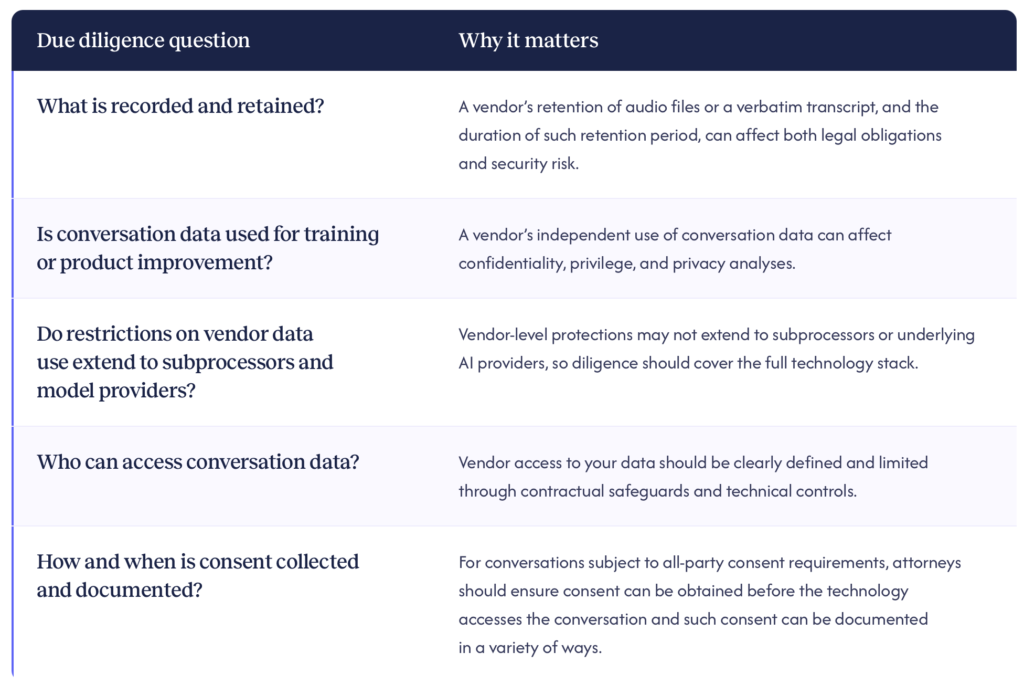
How AI Vendor Relationships Affect Attorney-Client Privilege
In United States v. Heppner, a federal district court held in February 2026 that a defendant’s exchanges with the public version of Claude were not privileged because the platform could train on user data, eliminating a reasonable expectation of privacy.[8] The ruling in Heppner, however, does not mean that every use of AI waives privilege. Rather, Heppner applies longstanding principles governing third-party involvement in privileged communications. A third party may fall within the privilege when engaged at counsel’s direction to assist in providing legal advice. See United States v. Kovel, 296 F.2d 918, 921–22 (2d Cir. 1961). Heppner itself acknowledged that an AI tool used at counsel’s direction might, depending on the circumstances, function similarly to such an agent.[8]
The Otter.AI litigation reflects a parallel distinction under CIPA. At the pleading stage in August 2026, the court treated a vendor acting solely at a user’s direction differently from one alleged to independently retain and use conversation data for its own commercial purposes.[7]
Before using technology in privileged conversations, lawyers should evaluate the product architecture and governing terms together to assess whether the vendor functions more like an agent of the attorney or an independent user of the communication because this distinction can materially affect the privacy and privilege analysis.
Why Consent Should Be a Layered Workflow, Not a Checkbox
Attorneys can collect and document required consents through engagement-letter language, but it rarely addresses every participant or conversation. Existing clients, witnesses, consultants, co-clients, and other third parties may participate in conversations not governed by an engagement letter. Thus, a responsible consent framework should be layered and operationalized, including:
- Standing disclosure and consent language in the engagement letter;
- Conspicuous notice for virtual meetings;
- Affirmative verbal consent for telephone or in-person conversations;
- A process for participants who decline or join after processing has begun; and
- A contemporaneous record of when consent was obtained.
The objective is not to accumulate disclaimers. It is to make consent reliable across virtual, telephone, and in-person conversations. Well-designed technology can assist in operationalizing an attorney’s approach to collecting and documenting consents.
What Is Legal Conversational Intelligence
General-purpose AI notetaking tools are principally designed to document what was said. Legal Conversational Intelligence™ is designed to support attorneys during and after legal conversations. Querious achieves this objective by surfacing relevant legal issues and follow-up questions in real-time and generating structured notes, follow-up communications, and billing entries after a conversation.
Querious states that by default it does not retain meeting audio or full transcripts after a conversation, does not use conversation data to train AI models, operates in a SOC 2 Type II-certified environment, and allows attorneys to customize retention periods. These safeguards do not replace the attorney’s own legal and ethical analysis. Instead, they illustrate how legal-specific architecture can support responsible AI implementation.
Why Responsible AI Adoption Requires More Than Software
Responsible implementation of AI requires more than selecting the right product. It also requires understanding the legal and ethical implications of incorporating that product into an attorney’s workflow. Compliance cannot be reduced to a software feature. A responsible legal technology vendor should understand the guardrails and not only deliver a product, but a pathway to implement that product responsibly.
This principle is central to the Querious-BHBA relationship. On September 15, 2026, BHBA hosted Beyond the AI Notetaker: How to Use AI Responsibly in Client Conversations, a program focused on the legal, ethical, and practical considerations involved in using AI during attorney-client conversations. The objective is not AI adoption for its own sake, but responsible implementation: selecting technology whose architecture reflects the sensitivity of attorney-client conversations and pairing it with practices, policies, and support designed around the legal and ethical obligations of the profession.
Are you a BHBA member? Unlock your exclusive Querious benefits.
Through our partnership with the Beverly Hills Bar Association, BHBA members have access to exclusive benefits from Querious.
See what’s available to you → Explore your BHBA member benefits
Endnotes
- [1] Beverly Hills Bar Association, "Beverly Hills Bar Association Wins Both CLE Awards in The Recorder’s Best Of 2026 - Voters Choose BHBA Two Years Running." Source
- [2] Matthew M. Beier, "Rising Claims, Shifting Risks - A 2025 Malpractice Snapshot for Wisconsin Lawyers," 99 Wisconsin Lawyer 45-47 (Feb. 2026). Source
- [3] State Bar of California, "Ethics & Technology Resources" and updated Practical Guidance for the Use of Generative Artificial Intelligence in the Practice of Law (approved May 14, 2026). Source
- [4] State Bar of California, "Proposed Amendments to the Rules of Professional Conduct Related to Artificial Intelligence" (second public-comment deadline Aug. 6, 2026). Source
- [5] California Legislature, SB-574 Attorneys, arbitrators, judicial officers, and alternative resolution providers (Section 1). Source
- [6] Cal. Penal Code sec. 631(a); Javier v. Assurance IQ, LLC, No. 21-16351 (9th Cir. May 31, 2022). Source
- [7] In re Otter.AI Privacy Litigation, No. 5:25-cv-06911-EKL, Dkt. 68 (N.D. Cal. Aug. 13, 2026). Source
- [8] United States v. Heppner, No. 1:25-cr-00503-JSR, Dkt. 27 (S.D.N.Y. Feb. 17, 2026). Source