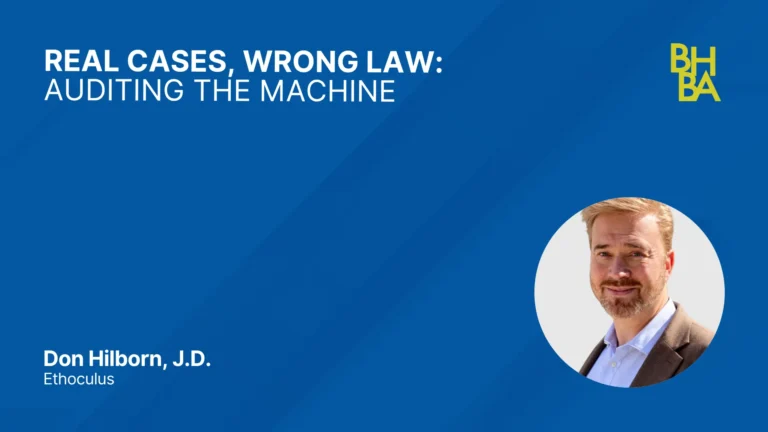
Don Hilborn was a coder and technologist long before he was a lawyer, and he never stopped being one. On February 1, 2003, he was the data guy on Boeing’s NASA Systems team when Space Shuttle Columbia broke apart on reentry. The experience taught him what the accident investigators would later document: an organization can have the right data and still reach the wrong conclusion if no one questions it. It also gave him the name he still works under, DonTheDataGuy™.
He carried that discipline into the litigation that followed the 2010 Deepwater Horizon blowout at BP’s Macondo well. There he did forensic work on electronically stored information, tracing where data came from, what touched it, and whether it could bear the weight a case placed on it.
Today he applies the same method to artificial intelligence. Hilborn writes the Ethoculus newsletter on AI, evidence and the law. He also builds Ethoculus, an open-source, local-first AI platform designed, in his words, to make AI “visible enough to challenge.” His Ethoculus Probe cross-examines AI models with controlled experiments. It gives a model a clear legal rule, then layers on prestige claims, repetition, false consensus and outcome pressure to see whether the answer bends. It checks whether cited sources actually exist, whether a model caves to a confident user who is wrong, and whether instructions hidden in a document can hijack it. The model under test and the model grading it run on different platforms, so no AI grades its own work.