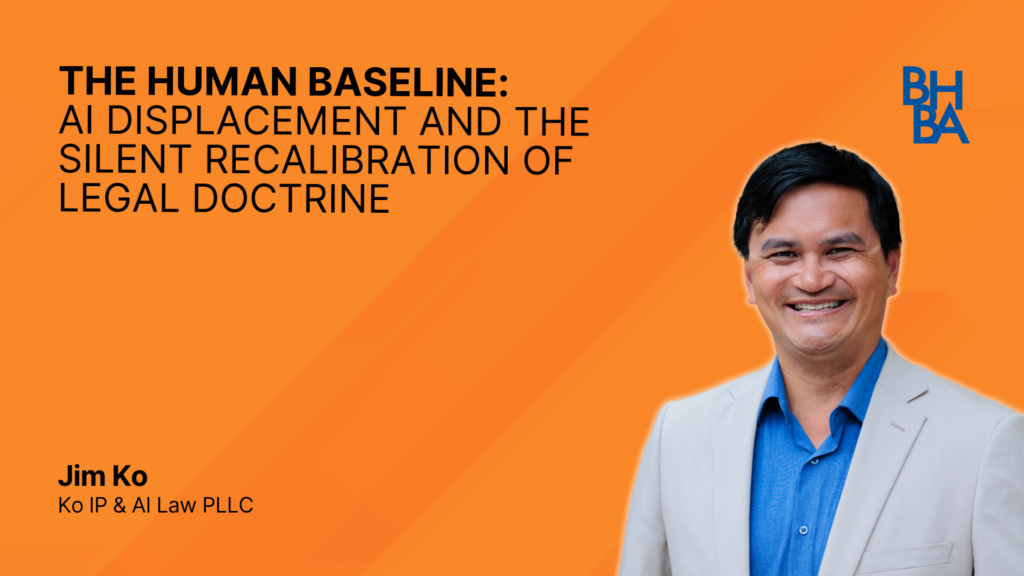
Federal doctrine across copyright, institutional free speech, and Title VII embeds human-scale predicates, Human Creativity, Observational Capacity, and Attributable Agency, that operate as invisible structural conditions the law never had to name. When AI displaces them, enacted doctrine loses coherence without a word of the statute changing. This phenomenon is termed the silent recalibration, and the Human Baseline framework is presented as the interpretive discipline required to address it. The framework surfaces across three doctrinal areas:
Copyright: Machine-scale ingestion of billions of works is treated as equivalent to human reading, without examining whether the Human Creativity predicate survives.
Institutional free speech: Platforms claim First Amendment editorial discretion for algorithmic curation while simultaneously disclaiming accountability for the content that curation produces.
Title VII: AI hiring systems displace Observational Capacity and Attributable Agency simultaneously, generating operative criteria no human specified and no human can validate.
Attendees leave with an interpretive tool that identifies when predicate displacement has occurred, forces courts and clients to confront who has authority to recalibrate it, and insists on congressional or constitutional authorization before doctrine bends to the technology, a discipline applicable across any practice area where AI has entered the picture.
This OnDemand CLE program earns 1.25 hours of General credit in California. It aired August 28, 2026 and features Marc E. Hoag.
Named Best CLE Provider and Best Online CLE Provider by The Recorder in both 2025 and 2026. Built for lawyers, by lawyers, to keep you ahead.




Watch on your phone, tablet, or computer, whenever it fits your schedule.
Your certificate is emailed automatically and saved in My BHBA+.
My BHBA+ shows your credits, deadlines, and progress in one place.